Resources for Reseachers

RR-650 to RR-601

RESOURCES FOR RESEARCHERS

List of Resource Videos

RR-650 to RR-601


Resource Call Number : RR-601 / AP 51

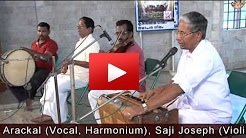
AP 51 - Lonappan Arackal and team in conversation with Dr. Joseph J. Palackal.

The melodies and memories that Mr. Lonappan Arackal shares with us in this video are significant because he is a member of the transitional generation that saw the transference of the Syro Malabar liturgy from Syriac to Malayalam (July 3,1962). Lonappan has been a church musician for the last 53 years. He learned the melodies from his father and grandfather who, too, were choir leaders. Thus, we have here a musical link to a melodic tradition that is older than a century.
Also Available Video Segment (s) - AP 51a to 51o



Aramaic Project video Notes
 

Resource Call Number : RR-602 / AP 52

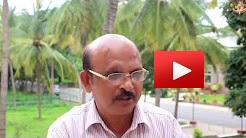
AP 52 - Mr. Sebastian Menachery in conversation with Dr. Joseph J. Palackal.

This interview is valuable, especially to musicologists and Church historians. Although not a professional musician, Sebastian Menachery reminisces, with great enthusiasm, melodies and memories from the Syro Malabar liturgy in the 1950s.
Also Available Video Segment (s) - AP 52a to 52s


Aramaic Project video Notes

Resource Call Number : RR-603 / AP 53


AP 53 - George Thaila in conversation with Dr. Joseph J. Palackal.

This is a rare, yet interesting example of singing a non-liturgical Marian devotional song in Malayalam to the melody of a popular Syriac chant. George Thaila, who was born into a musical family, recalls his early childhood experience of evening family prayer at his home at Kuninji, in the Idukki District of Kerala.


Aramaic Project video Notes


Resource Call Number : RR-604 / AP 54

AP 54 - Fr. Jose P Kottaram in conversation with Dr. Joseph J. Palackal.

Fr. Jose Kottaram, who immersed himself in the Syriac tradition of the Syro Malabar Church from his childhood days, gives us requiem versions of melodies for three chants: “Slīwā dahwā lan,” O dez damman,” and “Qadkāyen.” He says that he learned these melodies by listening to requiem Raza that used to be celebrated frequently during those days in his parish. This are examples of singing the same text in two different ways to create different effects in the liturgy.
Also Available Video Segment (s) - AP 54a to 54o


Aramaic Project video Notes


Resource Call Number : RR-605 / AP 55

AP 55 - Pre-screening comments by Dr. Joseph J. Palackal on the Aramaic Project.

Pre-screening comments by Dr. Joseph J. Palackal on the Aramaic Project at the Conference on the Music of South, Central, and West Asia. Harvard University, 4-6 March 2016.


Aramaic Project video Notes


Resource Call Number : RR-605 / AP 55

AP 56 - Syriac melodies on the saxophone by Johny P. David

Johny P. David, a great blessing. Syriac chants on saxophone Johny P. David, who plays Syriac melodies on the saxophone, is a great blessing to the well-wishers of the Aramaic Project was well as anyone who is interested in the history of the Syriac chant repertoire in Kerala, India.


Aramaic Project video Notes


Resource Call Number : RR-607 / AP 57

AP 57 - Bilingual singing of Qambel Maran.

The idea of singing the same chant in its original Syriac text and its Malayalam translation came up during my interview with the Major Archbishop, George Cardinal Alencherry, the head of the Syro Malabar Church (see Aramaic Project 60 ). 


Aramaic Project video Notes


Resource Call Number : RR-608 / AP 58

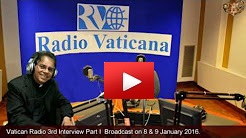
AP 58 - Fr. William Nellikkal's interview of Dr. Joseph J. Palackal for the Malayalam section of the Vatican Radio.

full interview. Broadcast in five parts.


Aramaic Project video Notes


Resource Call Number : RR-609 / AP 59a

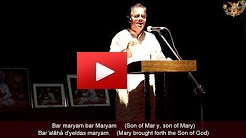
AP 59a - Speech about a unique Syriac chant from the funeral services for priests in the Syro Malabar Church. by Dr. Joseph J. Palackal.

Dr. Joseph J. Palackal sings and speaks about a unique Syriac chant from the funeral services for priests in the Syro Malabar Church. This is an excerpt from his lecture on "What is Christian Musicology of India?" at Dharmaram College, Bengaluru, on 18 July 2014..


Aramaic Project video Notes


Resource Call Number : RR-610 / AP 60

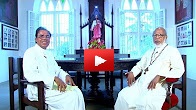
AP 60 - Mar George Cardinal Alencherry in conversation with Dr. Joseph J. Palackal , CMI.

Note: “My desire is that this Syriac tradition should be kept up”

This interview is a glorious moment in the history of the Aramaic Project. Major Archbishop Mar George Cardinal Alencherry, who is the head of the Syro Malabar Church, was gracious enough to grant this interview, which took place in a very relaxed and friendly atmosphere. The Archbishop spoke candidly; his Eminence’s mind is very much in tune with the goals of the Aramaic Project.


Aramaic Project video Notes

Our Mission

Christian Musicological Society of India is an international forum for interdisciplinary research, discussion, and dissemination of knowledge, on the music, art and dance of about thirty million Christians in India, who belong to a diverse set of communities and linguistic groups and follow a variety of liturgical traditions some of which date back to the early Christian era. Founded in 1999 by Dr. Joseph J. Palackal CMI, the Society hopes that such researches will draw attention to the lesser known aspects of India in connection with the rest of the world.

Image


TheCmsIndia.org

AramaicProject.com

ChristianMusicologicalsocietyofIndia.com


Contact Us

Address:
Josef Ross, I st Floor,
Peter's Enclave, Opp. Kairali Apts
Panampilly Nagar, Kochi , Kerala, India - 682036

Phone :  +91 9446514981 | +91 8281393984

Office in North America
Email :
info@thecmsindia.org

Email : library@thecmsindia.org